Mike’s face remained frozen on the dark phone screen after the video ended.
For several seconds, the parking lot held no sound except the ticking metal of cooling motorcycle engines.
I stared at my reflection in the glass.
Behind it, I could still see the last expression Thunder Mike had worn in the recording—exhausted, frightened, and determined to finish the promise before his body failed him.
Tommy’s fingers tightened around my hand.
“Ride now?” he asked again.
Those were only two words, but his mother reacted as though the ground had shifted beneath her.
Sarah pressed both hands over her mouth.
Tears spilled down her face, yet she made no sound.
“What is it?” I asked.
She looked from Tommy to me.
“He hasn’t asked for anything since Mike died.
He barely responds when I ask him questions.
Most days he points or pulls me toward what he needs.
But he hasn’t used his voice.
Not once.”
Tommy ignored us.
His attention remained fixed on my motorcycle.
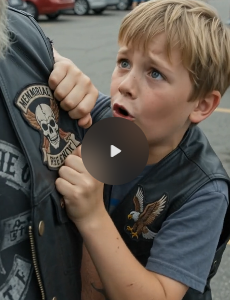
He traced the eagle patch on my vest, then touched the memorial patch beneath it.
His finger moved slowly around the border, following the stitching as if checking that every piece was still where his father had promised it would be.
“Ride,” he repeated.
Sarah shook her head immediately.
“Tommy, no.
You’ve never been on a motorcycle.”
“Yes,” he said.
The certainty in his voice stopped her.
He pointed toward her car.
“Helmet.”
Sarah’s face changed.
Confusion came first, followed by recognition and then another wave of grief.
She stood on unsteady legs and walked to the trunk of her car.
When she returned, she carried a small black motorcycle helmet covered in colorful stickers.
It was not a toy.
It was a high-quality child-sized helmet with a secure chin strap, padded lining, and a visor Tommy clearly knew how to lift.
“Mike bought it before he got sick,” she said.
“I thought it was just another one of his plans for someday.”
She turned the helmet over.
Inside, written on a strip of tape in Mike’s blocky handwriting, were the words: FIRST RIDE WITH EAGLE.
Big Jim looked away.
Phoenix rubbed the back of his neck and stared toward the road.
Dutch, who had once stitched his own leg closed after a crash because he refused to miss a charity ride, wiped his eyes with the heel of his hand.
Mike had not merely hoped Tommy would find us.
He had prepared for it in precise, careful steps.
Sarah held the helmet against her chest.
“I don’t know if I can let him do this.”
“You don’t have to decide because Mike asked,” I told her.
“You decide because you’re his mother.
Nothing happens unless you say so.”
That mattered.
Mike’s wishes carried weight with us, but Sarah had spent six months keeping their son alive through grief we had not even known existed.
She had earned the right to say no without being pressured by twenty years of brotherhood.
Tommy walked to her and touched the helmet.
“Daddy practiced,” he said.
Sarah stared at him.
“Practiced what?”
Tommy placed his hands in front of him as though gripping someone’s jacket.
Then he positioned his feet apart and leaned forward slightly.
“Hold Eagle.
Feet still.
No let go.”
Sarah closed her eyes.
“He taught you in the living room,” she whispered.
Tommy nodded.
A memory seemed to find her then.
She told us Mike had spent evenings sitting backward on a dining chair while Tommy climbed onto another chair behind him.
Mike would start videos of motorcycle engines, letting the low rumble fill the room while he guided Tommy’s hands to his waist.
Sarah had assumed it was a game.
Now she understood that Mike had been rehearsing a future he knew he would never live to see.
I took the helmet gently from her.
“We go no faster than walking speed,” I said.
“One circle of the empty side lot.
Jim blocks the entrance.
Phoenix walks beside us.
You stay where Tommy can see you the whole time.”
Sarah looked at her son.
Tommy did not beg.
He did not cry.
He simply waited, one hand resting on the eagle patch.
“All right,” she whispered.
“One circle.”
The men moved without needing instructions repeated.
Big Jim rolled his bike across the entrance to keep cars out.
Spider asked the diner manager to hold traffic for a minute.
Dutch checked my rear pegs and seat as though he were inspecting a machine before a cross-country run.
Phoenix crouched beside Tommy and showed him the hot parts of the motorcycle he must never touch.
Tommy listened to every word.
I fitted the helmet over his head and secured the strap.
He lifted the visor once, lowered it, then tapped the side twice.
“Mike teach you that too?” I asked.
“Ready signal,” Tommy said.
My throat tightened.
I climbed onto the bike and steadied it with both boots planted on the ground.
Phoenix lifted Tommy carefully onto the seat behind me.
The boy placed his feet exactly where they belonged and wrapped both arms around my waist.
His helmet pressed against the center of my back.
For one strange second, I remembered Mike riding behind me years earlier after his motorcycle broke down.
He had complained the entire way, insisting no grown man should have to ride as a passenger.
At the next gas station, he had told everyone I drove like an old woman carrying soup.
The memory nearly broke me.
I turned the key.
“Starting,” I warned.
Tommy tightened his grip.
The engine came alive.
Sarah flinched at the sound, but Tommy did not.
His entire body settled against me.
The rigid tension in his arms loosened.
Through my vest, I could feel a soft vibration from his chest.
He was humming with the engine.
We rolled forward at barely more than walking pace.
Phoenix stayed beside us.
Sarah stood in the center of the lot, turning as we circled her.
Tommy kept his helmet facing forward until we passed her.
Then he lifted one hand for half a second and waved.
Sarah laughed through her tears.
It was the first joyful sound any of us had heard that day.
We made one circle.
Then Tommy tapped my side twice.
“Again,” he said.
I looked at Sarah.
She held up two fingers.
So we made another.
On the third pass, the men began walking alongside us.
Big Jim’s boots struck the asphalt on one side.
Phoenix stayed on the other.
Spider and Dutch followed a few steps behind, like an honor guard
moving at the speed of a child learning that the world could still be safe.
When we stopped, Tommy remained seated for a moment with his arms around me.
“Good vibration,” he said.
“Your daddy loved that sound,” I told him.
“Daddy loud.”
I smiled.
“Your daddy was very loud.”
Phoenix laughed first.
Then the others joined him.
Even Sarah smiled because anyone who had known Mike for five minutes knew the truth of it.
Tommy climbed down and immediately returned to the memorial patch.
“Where’s Daddy?” he asked.
The laughter disappeared.
Sarah took one step toward him, but I saw the fear in her face.
She had probably answered that question in a dozen careful ways.
None had reached him.
Maybe no answer ever could.
I lowered myself to one knee again.
“Your daddy rode ahead of us,” I said.
“Farther than we can ride today.”
“Alone?”
“No.” Dutch crouched beside me.
“The brothers who ride ahead wait for the rest of us.”
Tommy studied his missing finger, confirming the detail his father had taught him.
“Daddy waiting?”
“Yes,” I said.
“But while he waits, he gave us a job.”
Tommy touched the eagle.
“Promise.”
“That’s right.”
He looked around the circle of men, then said, “Daddy said Eagle teach me to fly.”
Every eye turned toward me.
Mike had chosen his words carefully.
He knew Tommy would remember an image more easily than an explanation.
The eagle was not only a patch.
It was an instruction.
Teach him to fly.
I looked at Sarah.
“What did he mean?”
She wiped her face and opened another file on her phone.
It contained short notes Mike had written during the last months of his life.
Some were practical: insurance information, therapy contacts, the location of important documents.
Others were messages for Tommy’s future birthdays.
One note had my road name at the top.
Sarah read it aloud.
“Eagle taught half this club how to ride, fix an engine, and get home when pride said we were too lost to ask directions.
I don’t need him to make Tommy a biker.
I need him to show my boy that fear does not get the final mile.”
I could hear Mike saying it.
Even dying, he had managed to insult my sense of direction.
Sarah continued.
“Tommy may never want crowds.
He may never speak easily to strangers.
Do not try to change who he is.
Give him a road where he can breathe, people who keep their word, and a reason to believe that losing me did not mean losing everyone.”
The note ended with one sentence.
“Family is who stays after the engines stop.”
For years, our club had repeated a simple promise: when something happened to one of us, the rest looked after the family left behind.
We had delivered groceries after surgeries, repaired roofs, covered rent, and sat through long hospital nights.
But Mike had kept Sarah and Tommy separate from us.
At first, that hurt.
Then Sarah explained.
Crowds overwhelmed Tommy.
Sudden visitors could send him into panic.
Mike worried that twenty loud motorcycles appearing outside their home would feel like an invasion instead of support.
He also feared the club would treat Tommy as fragile or broken.
“He didn’t doubt your loyalty,” Sarah said.
“He doubted
whether he had enough time to teach everyone how Tommy needed to be loved.”
That sentence humbled every man standing there.
We had thought brotherhood meant arriving fast and in force.
Mike understood that loving his son might require the opposite: patience, predictability, quiet voices, and permission to step back.
Big Jim removed his club gloves and placed them on the seat of his bike.
“Then you teach us,” he told Sarah.
“We’ll learn.”
She looked around the group.
“All of you?”
“All of us,” Phoenix said.
Spider nodded.
“But at Tommy’s speed.”
Tommy had begun walking around the motorcycles, examining patches and chrome.
He did not touch anything without asking.
When he reached Dutch, he pointed to the damaged hand.
“Accident?”
“Chain snapped,” Dutch said.
“Daddy said you saved Phoenix.”
Dutch looked at Phoenix.
That story had happened twelve years earlier on a mountain road.
A broken chain had locked Phoenix’s rear wheel.
Dutch had forced his own bike between Phoenix and a guardrail, losing part of a finger when both motorcycles went down.
Mike had told Tommy the story not as entertainment, but as evidence.
These men stay.
Sarah opened the back door of her car to prepare Tommy for the trip home.
He resisted at first, not with a scream, but by holding my vest again.
“Sunday,” he said.
I glanced at Sarah.
“Would Sunday work?”
Her expression carried fear, relief, and exhaustion at once.
“Mike set aside money for lessons and fuel.”
“No,” I said.
Every man answered with me.
“No.”
Sarah blinked.
“Family doesn’t pay,” Big Jim told her.
“You may regret saying that when he wants to ride every week,” she said.
Tommy climbed into the car and fastened his seat belt.
“Every Sunday,” he announced.
Phoenix laughed.
“Sounds like the schedule is settled.”
Before Sarah drove away, we exchanged phone numbers and agreed on rules.
No surprise visits.
No large gatherings unless Tommy approved them in advance.
No touching him without asking.
The motorcycles would remain off when he first arrived, and only one engine would start at a time.
Sarah expected resistance.
Instead, twenty rough men treated those rules like road law.
The following Sunday, Tommy arrived at the clubhouse at nine in the morning.
We had cleaned the quiet back room and removed the buzzing fluorescent light that bothered him.
Dutch created a picture board showing the order of the day: helmet, safety check, short ride, snack, home.
Phoenix covered his flame tattoo until Tommy asked him to uncover it.
Big Jim shaved nothing, because the mustache was part of Tommy’s map.
Only four motorcycles came that first week.
We rode ten slow miles along Mike’s favorite river road.
Tommy did not speak during the ride.
He communicated by taps: once to slow down, twice to stop, three times to say he was all right.
Mike had designed the signals during their living-room rehearsals.
At the overlook, Tommy stood beside me and watched the river.
“Daddy road,” he said.
“Yes.”
“Daddy fast.”
“Too fast,” I said.
Tommy considered that.
“Mom said same.”
Week by week, the rides grew longer.
So did Tommy’s trust.
He learned how to inspect tire pressure, how to check a helmet strap, and why a motorcycle chain needed the right amount of slack.
We learned that he
disliked applause, loved maps, and could identify an engine problem by a change in rhythm before most of us noticed it.
He did not suddenly become a different child.
He still struggled with noisy restaurants, unexpected changes, and unfamiliar people.
Some Sundays he arrived, looked at the sky, and decided he could not ride.
On those days, nobody argued.
We sat in the quiet room and sorted bolts, cleaned tools, or traced routes on paper.
Sarah told us that respecting his no was one of the greatest gifts we gave him.
His speech returned gradually and selectively.
First came names.
Then requests.
Later, short stories about school, engines, and dreams he had about his father.
His therapists did not call it a miracle.
They called it progress built through safety, repetition, and relationships he chose to trust.
To us, every new sentence still felt sacred.
Three months after the parking lot, Sarah attended her first club dinner.
Tommy sat between me and Big Jim with headphones resting around his neck.
When the room became too loud, he lifted one finger.
Twenty conversations lowered at once.
Sarah watched that happen and began to cry.
“What did we do wrong?” Jim asked, panicked.
“Nothing,” she said.
“That’s why I’m crying.”
Six months after Tommy found my vest, we rode to Mike’s memorial marker beside the old river road.
This time, twenty motorcycles came.
We started them one at a time so Tommy could prepare for each new layer of sound.
He rode behind me wearing the black helmet Mike had bought.
Sarah followed in a car with Phoenix’s wife, who had become her closest friend.
At the marker, Tommy removed his gloves and traced his father’s name with one finger.
Nobody rushed him.
Nobody filled the silence.
Finally, he turned toward us.
“Daddy told me promises are roads,” he said.
“You have to keep going or they stop somewhere.”
I swallowed hard.
“Your daddy was right.”
Tommy looked at every man gathered there—the mustache, the flames, the missing finger, the silver ring, the eagle.
Then he said, clear enough for all of us to hear, “Daddy says thank you for keeping yours.”
Twenty grown men in leather cried beside that road.
No one looked away.
Sarah stepped beside me and placed her hand over the memorial patch.
“He knew you would come through.”
“I wish he had trusted us enough to tell us sooner.”
“He trusted you with the part that mattered most.”
Tommy approached and grabbed my vest exactly as he had in the parking lot.
But there was no panic in his grip now.
He checked the patches in their familiar order, ending with his father’s memorial.
“Eagle keeps promises,” he said.
“Always, little brother.”
He put on his helmet and climbed onto the motorcycle behind me.
As the engines started, the sound rolled across the river valley like distant thunder.
Tommy rested his helmet between my shoulders and began humming with the vibration.
Sarah stood beside the marker, smiling through her tears.
Mike had feared that death would leave his son without a map.
Instead, he had turned every scar, tattoo, patch, and story into a set of directions home.
I eased the motorcycle onto the road.
Tommy’s arms tightened around my waist.
Ahead of us, twenty bikes formed
a long, steady line through the morning light.
Family was not who made the most noise when tragedy arrived.
Family was who learned how to stay after the engines stopped.